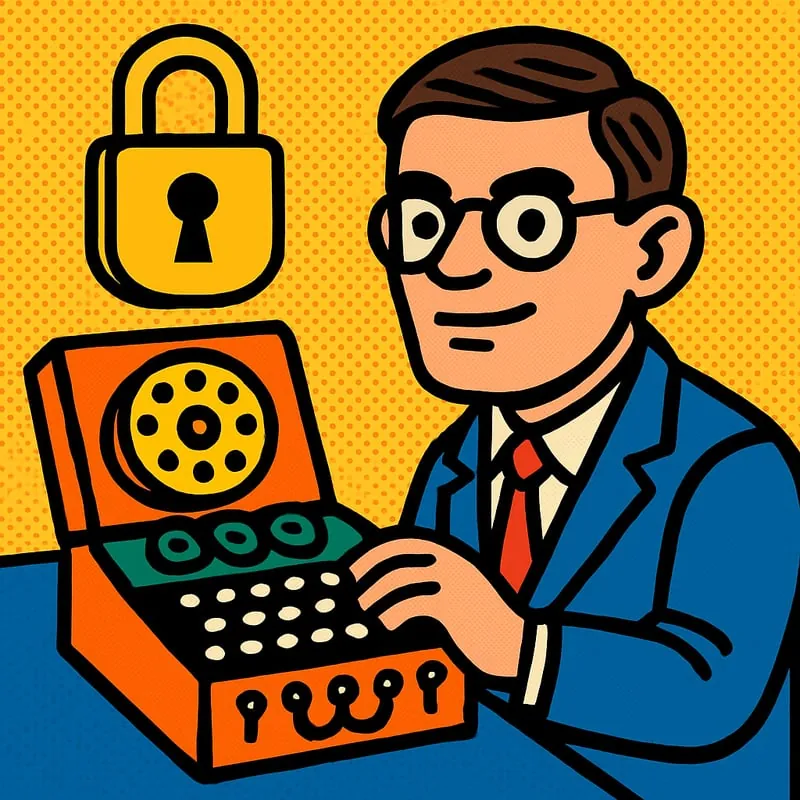
Alan Turing was a shy, brilliant English mathematician who liked solving puzzles and running marathons. In 1936 - before computers really existed - he wrote a paper imagining a machine that could follow any set of instructions. We now call that idea a Turing Machine, and it is the foundation of every computer ever built.
When World War II started, Britain needed him. He went to a secret country house called Bletchley Park, where teams of codebreakers were trying to crack the German Enigma machine. Turing helped design a clicking, whirring machine called the Bombe that could test thousands of code settings in minutes.
The work was so secret that nobody knew about it for decades. Historians now think Turing’s codebreaking saved millions of lives and shortened the war by around two years. He is on the £50 note in Britain and is remembered as one of the founders of computer science.