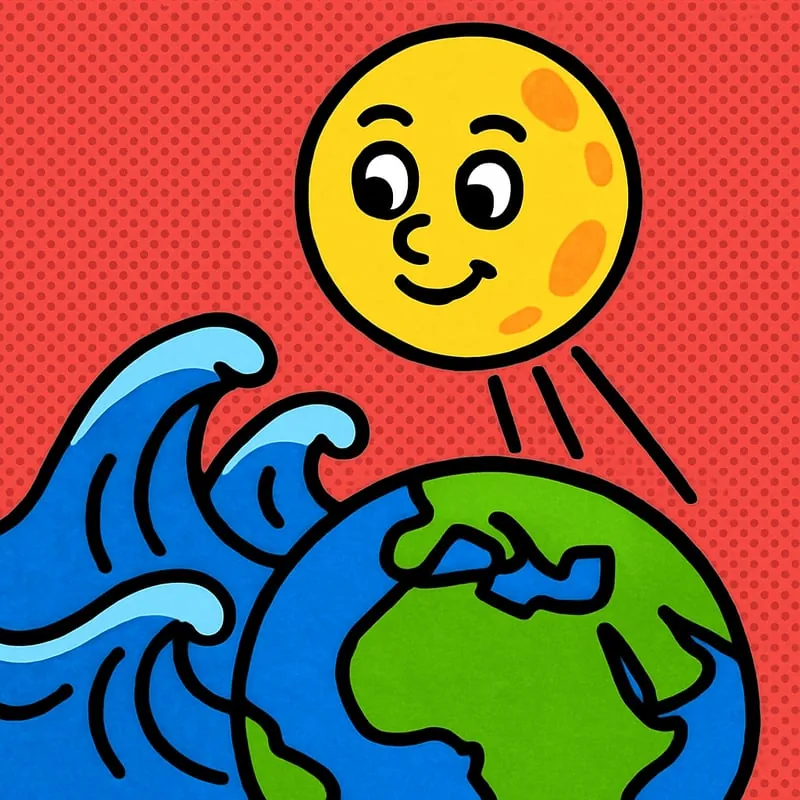
Tides are the slow rise and fall of sea level, happening roughly twice a day everywhere on Earth’s coastlines. The Moon’s gravity is the main cause. Even though the Moon is about 240,000 miles away, its gravity is strong enough to noticeably tug Earth’s oceans.
The Moon pulls hardest on whichever part of Earth is closest to it, lifting a bulge of water toward the Moon. Less obvious is that there’s a second tide bulge on the exact opposite side of Earth - because gravity also pulls Earth itself slightly toward the Moon, and the water on the far side gets “left behind.” Two bulges at all times: one facing the Moon, one facing away.
As Earth spins on its axis, every coastline rotates through these two bulges every 24 hours, experiencing two high tides and two low tides. The Sun also pulls slightly on the oceans, so when the Sun and Moon line up (at new moon and full moon), tides are extra big - called spring tides. When they’re at right angles, tides are gentler - called neap tides.