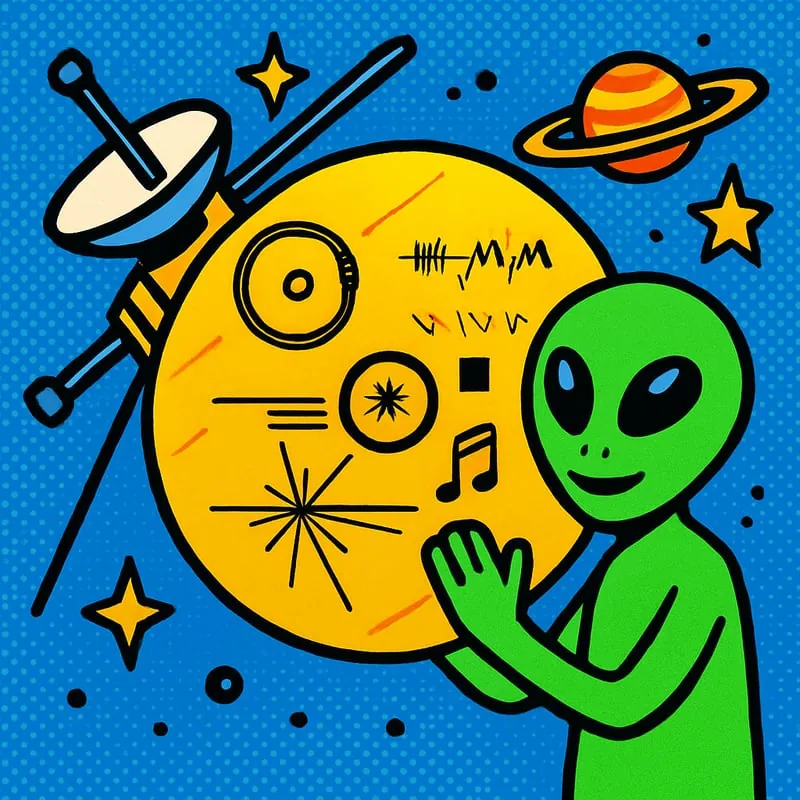
In 1977, when NASA was preparing the two Voyager spacecraft for their grand tour of the outer planets, scientists made an unusual decision. The Voyagers would eventually leave our solar system entirely - drifting into the space between stars. If anyone, or anything, ever found them, what should we say?
Astronomer Carl Sagan led a small team that designed an answer. Each Voyager was equipped with a gold-plated phonograph record - pressed with sounds and images chosen to represent Earth’s story. The records include 115 images: a baby, the Great Wall of China, a foot, a dolphin, a sunset. Greetings in 55 languages, from Akkadian to Wu. Music from around the world: a Pygmy lullaby, classical Indian raga, Beethoven, Chuck Berry’s “Johnny B. Goode.” Sounds of nature: a thunderstorm, a kiss, whale song, a heartbeat.
The records also contain instructions for playing them - drawn on the gold cover in simple diagrams. Both Voyagers are now drifting through interstellar space at about 38,000 mph. If they’re never found, the records will outlast Earth itself - gold doesn’t tarnish, and the discs are designed to last at least a billion years.