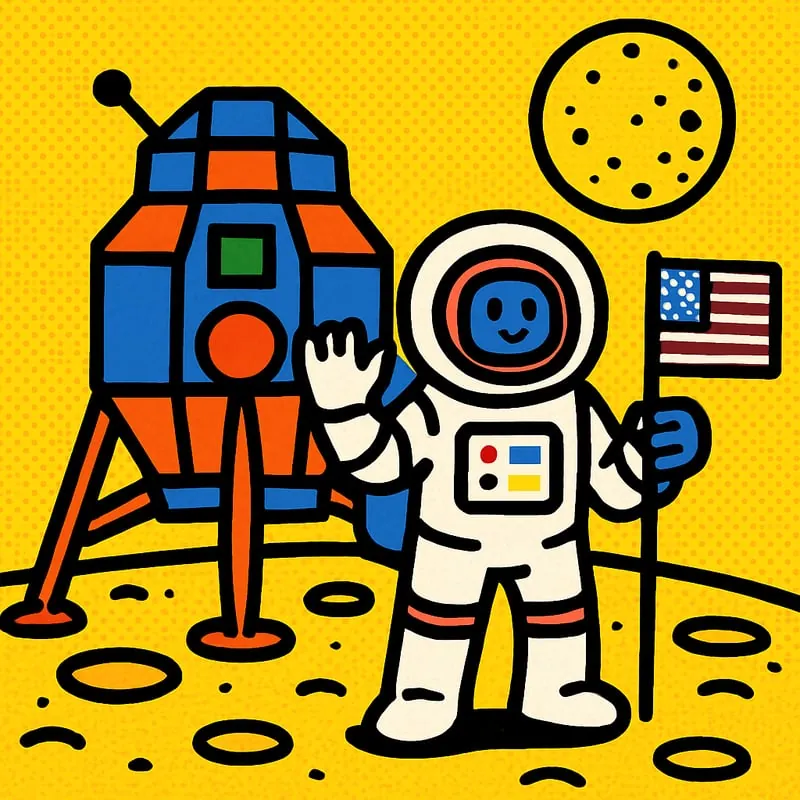
It was a Sunday afternoon in Texas when the radio crackled with the most-listened-to sentence in human history: "The Eagle has landed." Astronauts Neil Armstrong and Buzz Aldrin had just touched down on the surface of the Moon. About 600 million people - roughly a fifth of everyone alive at the time - were watching or listening as it happened.
The ride was not smooth. The lunar module Eagle had been steering itself toward a crater full of boulders the size of cars. Armstrong took manual control, flew over the danger zone, and landed with only about 30 seconds of fuel to spare. Mission Control in Houston later admitted that a few engineers had stopped breathing during the final descent.
Six hours after landing, Armstrong climbed down the ladder and stepped onto the gray dust of the Sea of Tranquility. His famous line - "That's one small step for man, one giant leap for mankind" - was beamed back to Earth across 240,000 miles of empty space. Aldrin joined him 20 minutes later. The two astronauts spent about two and a half hours outside, collecting 47 pounds of Moon rocks and setting up science experiments.
Before leaving, they planted a US flag, left behind a plaque that read "We came in peace for all mankind," and headed home. The Apollo program would land five more crews on the Moon over the next three years - and then no human has been back since 1972. Plans are now underway to return in the late 2020s.