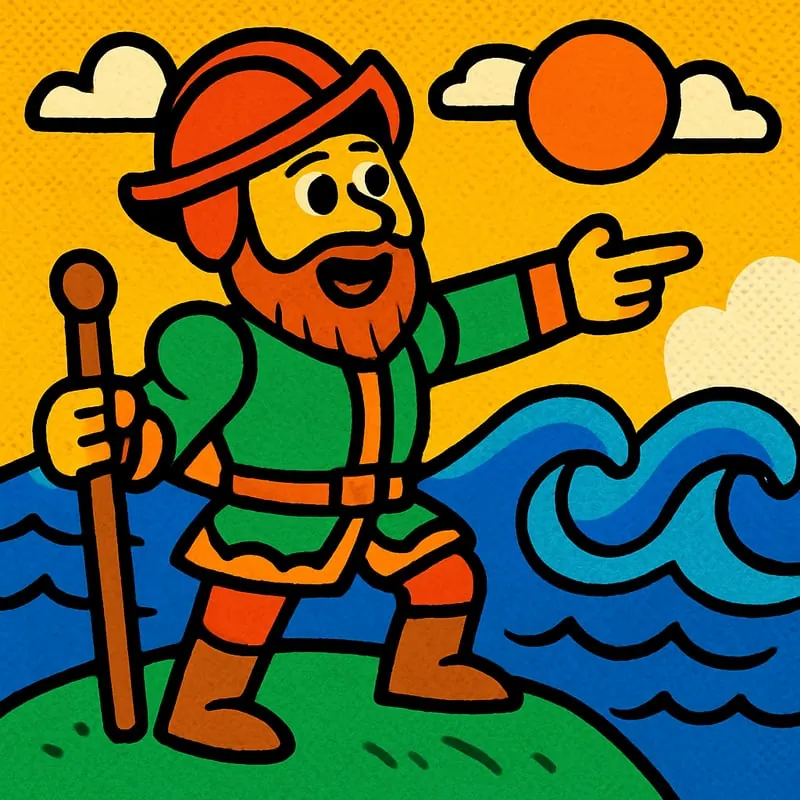
On September 25, 1513, a Spanish explorer named Vasco Nunez de Balboa pushed through the jungle of what is now Panama with a small group of men. They had been hiking for nearly a month, hacking through vines, crossing swampy rivers, and climbing steep hills, guided by local indigenous leaders. That morning, Balboa told his crew to wait at the bottom of the last hill so he could be the first to reach the top. When he did, he saw something no European had ever seen from the Americas: a shimmering blue ocean stretching all the way to the horizon.
Balboa fell to his knees and stared. Days later, he and his men reached the actual shoreline, and Balboa waded into the water in full armor, holding up a Spanish flag. He named it the South Sea, because from his viewpoint the ocean stretched south. The discovery proved that the Americas were a separate continent from Asia, not just an extension of it as many European mapmakers had guessed. It also showed there was a second, even larger ocean to be crossed if anyone wanted to reach Asia by sailing west.
The ocean Balboa spotted would later be renamed the Pacific by Ferdinand Magellan during his round-the-world voyage just a few years later. Today the Pacific Ocean is the largest body of water on Earth, covering about a third of the planet's surface, deeper than the average mountain is tall, and home to thousands of islands. Every container ship sailing from Los Angeles to Tokyo and every surfer riding a wave in Hawaii is traveling on the same ocean that one tired explorer first glimpsed from a Panamanian hilltop.