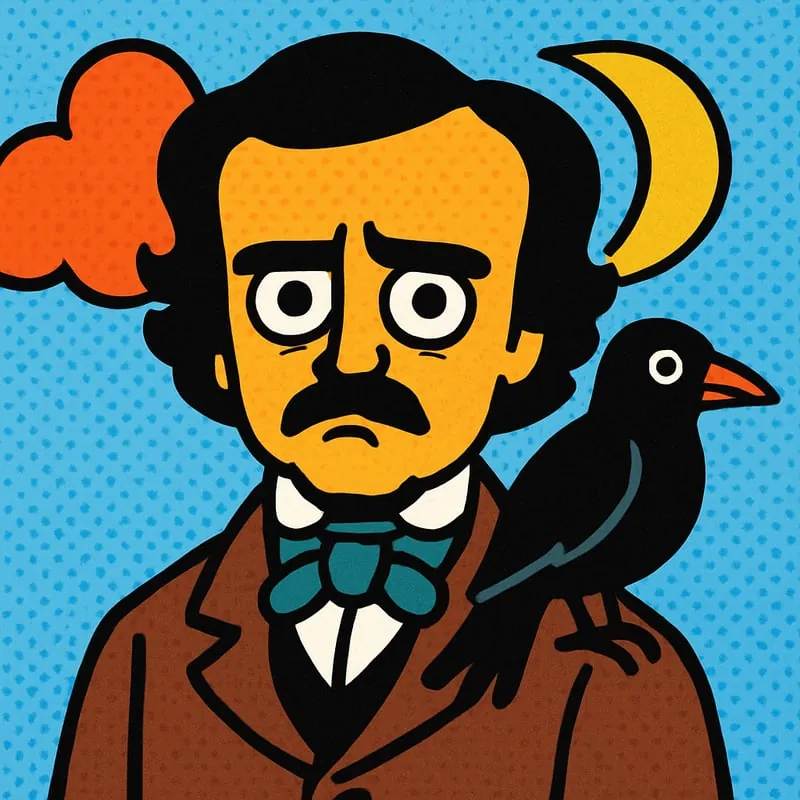
On 19 January 1809, in a chilly Boston boarding house, a baby named Edgar Poe was born to two travelling stage actors. His childhood was rough. His father walked out before Edgar turned two, and his mother died of illness soon after. A wealthy Virginia merchant named John Allan and his wife took Edgar in, adding 'Allan' to his name, but Edgar and his foster father never really got on. Edgar grew into a clever, moody young man who loved poems and gambled away too much money at university.
He tried being a soldier, a magazine editor, and a literary critic so sharp that other writers nicknamed him 'the tomahawk man.' He married his thirteen-year-old cousin Virginia, who later got very sick. Hard times never seemed to leave him. But at his writing desk Poe was inventing entirely new kinds of stories. In 1841 he wrote 'The Murders in the Rue Morgue,' starring a brilliant detective who solves a baffling crime using pure logic. That story basically invented the detective genre - without it there would be no Sherlock Holmes, no Hercule Poirot, no modern murder mysteries.
Poe also wrote mysterious, atmospheric tales that have spooked readers for nearly two centuries - 'The Tell-Tale Heart,' 'The Pit and the Pendulum,' and the long poem 'The Raven,' with its haunting refrain 'Nevermore.' He died in 1849 at only forty. Today his face appears on book covers, university buildings, and even an American football team - the Baltimore Ravens, named after his most famous poem.