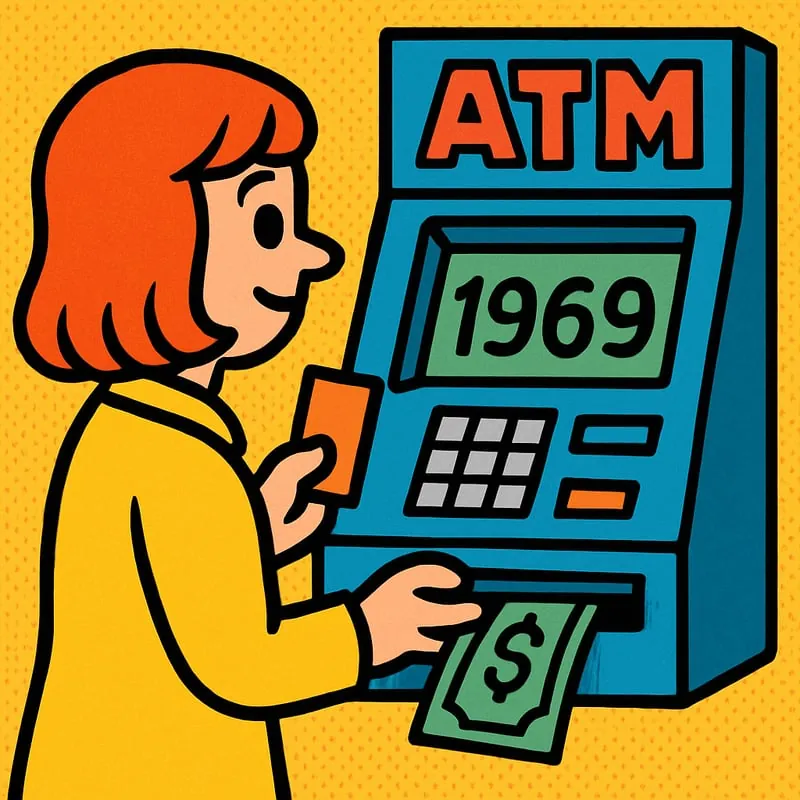
On September 2, 1969, a small crowd gathered outside a Chemical Bank branch in Rockville Centre, New York, to watch something most of them thought was a joke: a machine that gave out money. A bank executive walked up, slid in a special paper voucher, punched some buttons, and out slid real cash. The world's first American ATM was open for business with a cheerful sign that read, On Sept. 2 our bank will open at 9:00 and never close again.
Before that day, if you needed cash on a Saturday afternoon or after the bank closed at 3 p.m., you were out of luck. The early ATMs didn't use plastic cards yet; customers had to buy disposable paper tickets coated with a mild radioactive chemical that the machine could read. Plastic cards with magnetic stripes came a few years later, along with the now familiar four-digit PIN, which a Scottish inventor named John Shepherd-Barron originally wanted to be six digits until his wife said she could only remember four.
Today there are more than three million ATMs around the world, including ones at the South Pole, on cruise ships, and in tiny villages where they run on solar power. They quietly hand out trillions of dollars every year. The whole idea that you can stick a card into a wall anywhere on Earth and pull out the right money in the local currency started with that single experimental box on a Long Island sidewalk.