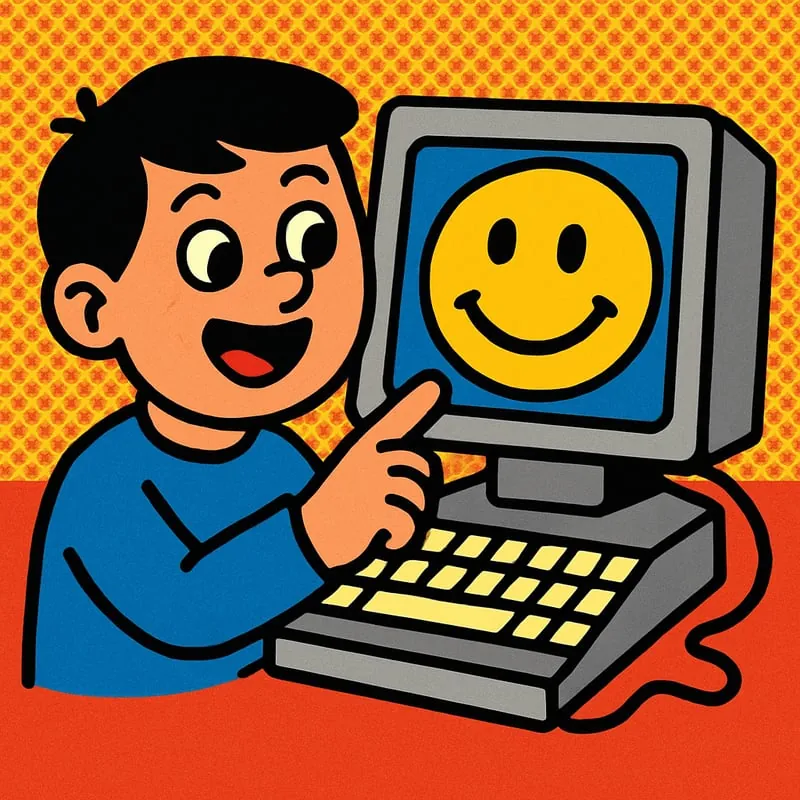
On September 19, 1982, at 11:44 in the morning, a computer science professor at Carnegie Mellon University named Scott Fahlman typed a short message onto an online bulletin board his students used. He had noticed that people kept misunderstanding jokes online, since you couldn't see anyone's face. So he suggested marking jokes with a tiny sideways smiley face made of three keyboard characters: a colon, a dash, and a closing parenthesis. He suggested using :-( for things that weren't jokes. With that, the world's first emoticon was born.
Fahlman's idea wasn't part of a big project. It was just a quick post tucked into a thread about elevator safety. The smiley spread anyway, jumping from one university bulletin board to the next, then into email and early chat rooms. Soon people were inventing their own emoticons for winking, sticking out tongues, and showing surprise. In Japan, a different style called kaomoji popped up, where you can read the face the right way up like (^_^). By the late 1990s, a Japanese phone designer named Shigetaka Kurita went further and created the first 176 emoji, the colorful little pictures that now fill every text conversation.
Fahlman's three little characters started something huge. Today people send around 10 billion emoji every single day. Smileys have official Unicode codes, museums display the original ones, and there is even a World Emoji Day every July 17. The simple realization that messages need feelings, not just words, turned a quick joke from a Pittsburgh professor into one of the most copied ideas in the history of writing.