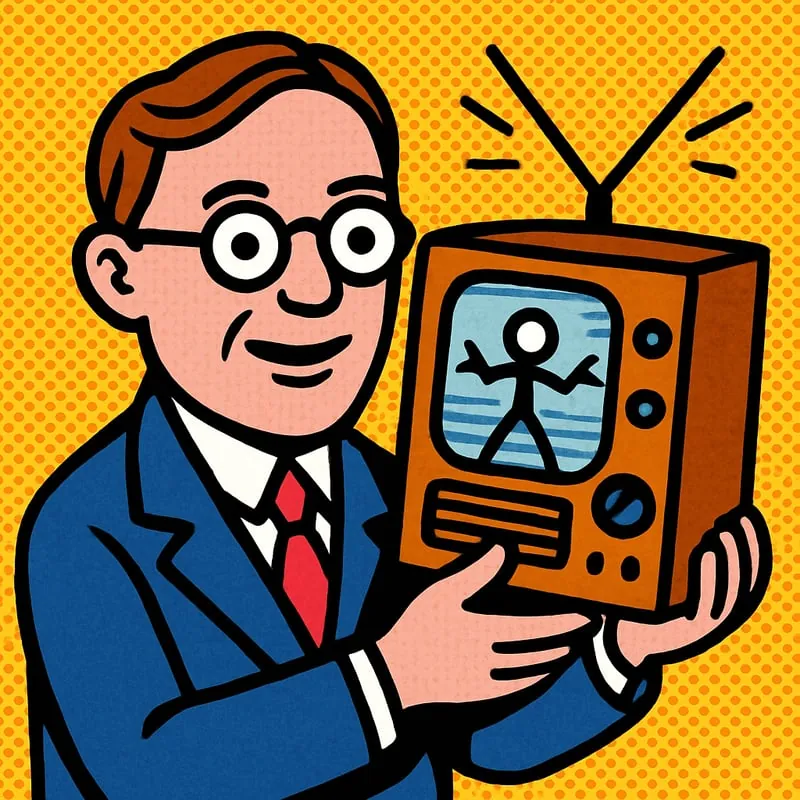
On February 25, 1928, the U.S. government handed out the first-ever license to broadcast television signals. It went to a busy inventor named Charles Francis Jenkins, who ran a tiny station called W3XK in suburban Washington, D.C. His broadcasts didn't look anything like today's TV. The pictures were tiny, blurry, orange-tinted images of moving silhouettes, sent through the air using spinning metal disks full of pinholes. Hardly any homes had a television to watch them on.
Charles Jenkins had been tinkering with moving pictures since he was a young man. Years earlier, he'd helped invent one of the first movie projectors, called the Phantoscope. By 1923 he'd figured out how to send moving images by radio waves, calling them 'radio pictures' or 'radiovision.' His station broadcast for about an hour each night, showing flickering images of dancers, boxers, and cartoons. Hobbyists built their own clunky receivers from kits and gathered around to watch the wobbly figures dance.
Within a few years, faster, sharper electronic TV systems would push out Jenkins's spinning-disk version, and his company went out of business. But the door was open. By the late 1940s, families across America were crowding into living rooms to watch baseball games, variety shows, and the news on glowing wooden boxes. Color TV came in the 1960s, then satellite, cable, streaming, and tiny screens in our hands. Every show your family watches today, from cartoons to sports, traces back to the wobbly orange shadows of Charles Jenkins's W3XK.