On February 15, 1564, a baby named Galileo Galilei was born in Pisa, Italy, the same city famous for its leaning tower. His father was a musician who wanted him to study medicine, but Galileo couldn't stop scribbling math problems in the margins of his textbooks. He switched to math and physics, and soon he was running experiments that other scholars thought were a waste of time, like rolling balls down ramps to measure how fast they sped up.
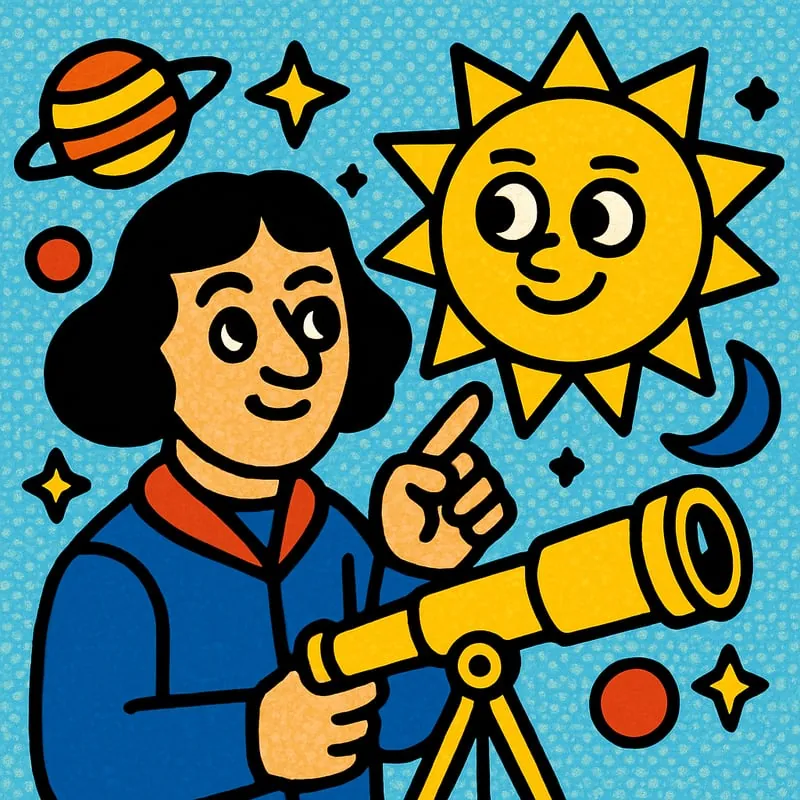
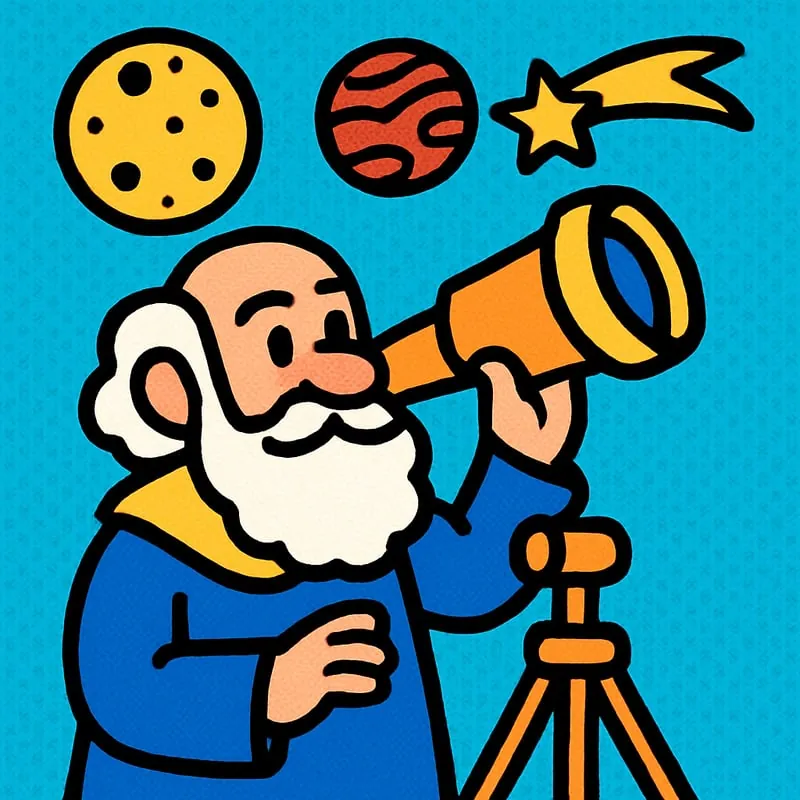
In 1609 Galileo heard about a strange new invention in the Netherlands called a spyglass. He built his own version, made it stronger, and pointed it not at far-off ships but at the night sky. What he saw rewrote astronomy. The Moon had craters and mountains, not the smooth perfect surface people had imagined. Jupiter had four little moons of its own, swinging around it like tiny clocks. Venus had phases like our Moon. Most shocking of all, his observations supported the idea that Earth orbits the Sun, not the other way around.
That got him in big trouble with the church, which insisted the Earth sat still at the center of everything. Galileo was put on trial in 1633 and forced to take back his words, then sent to live the rest of his life under house arrest. He kept writing anyway, even after going blind. Long after he died, scientists proved he'd been right all along. Today astronauts, planetary scientists, and every kid with a backyard telescope are walking in Galileo's footsteps.