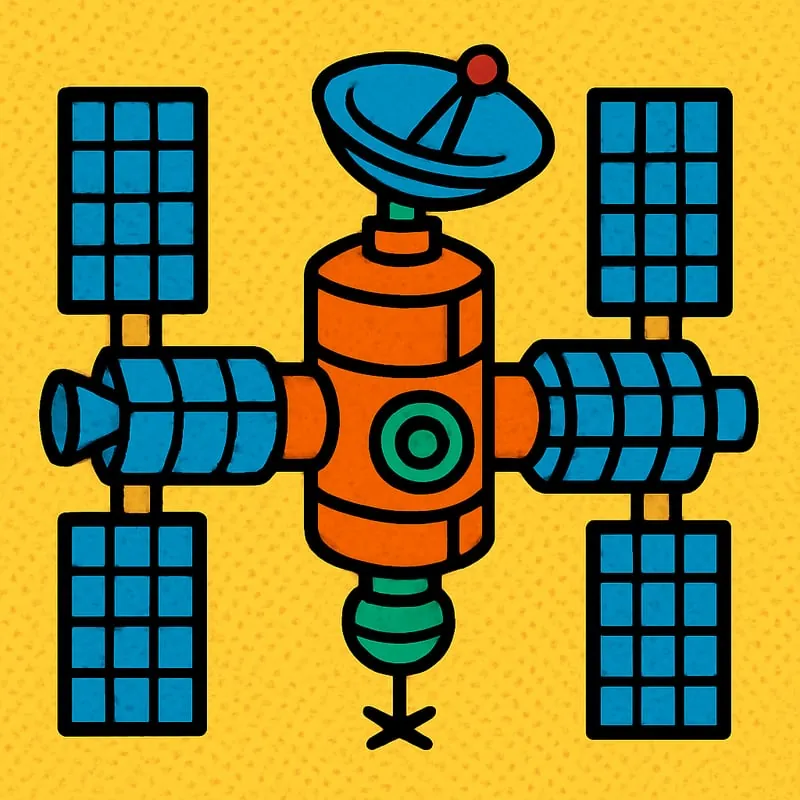
On November 20, 1998, a Russian rocket called a Proton blasted off from Kazakhstan carrying a chunky module roughly the size of a school bus. The module was named Zarya, which means sunrise in Russian, and it was the very first piece of what would become the International Space Station. Once Zarya reached orbit about 250 miles above Earth, its solar panels unfolded like silver wings and its engines fired to settle it into the right loop. The ISS had officially begun, even though it was still just one lonely module sailing through space.
Two weeks later, the Space Shuttle Endeavour caught up with Zarya and astronauts attached a second module called Unity, made by NASA. After that, piece by piece, more parts were launched and bolted on - a Russian section called Zvezda, a giant trellis of beams, gleaming solar arrays the length of football fields, and laboratories from Europe and Japan. Over the next twelve years, builders from 15 countries flew up dozens of missions, fitting the station together like a colossal Lego set. By 2011 the ISS had grown into the biggest single structure humans have ever put in space, weighing about 925,000 pounds.
Since November 2000, the station has been continuously lived in by astronauts and cosmonauts - that's more than 25 years of nonstop human presence in space. Crews have grown lettuce in microgravity, tested vaccines, watched giant storms swirl below, and snapped countless photos of Earth's curved blue edge. If you look up at the right time on a clear night, you can actually spot the ISS as a bright dot sliding silently across the stars, a floating laboratory built one piece at a time, starting with a single sunrise.