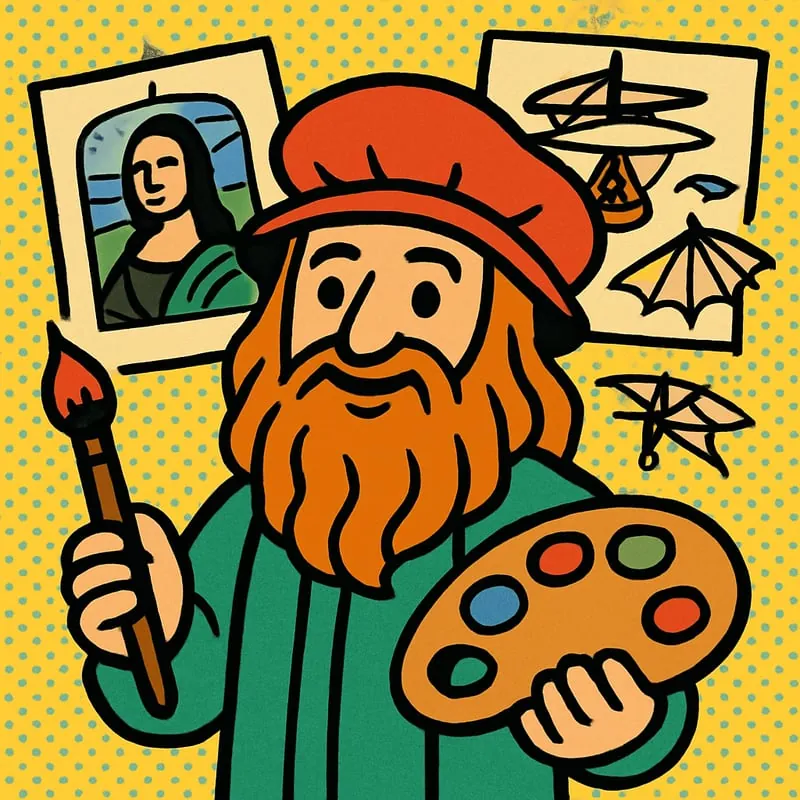
On May 2, 1519, in a stone manor house in Amboise, France, a 67-year-old man with a long white beard breathed his last. His name was Leonardo da Vinci, and according to legend, the King of France himself, Francis I, was holding his head as he died. Leonardo had spent his final years in France as the king's personal artist, engineer, and all-around genius-in-residence.
Leonardo left behind some of the most famous paintings in history - the Mona Lisa with her mysterious smile, The Last Supper on a crumbling monastery wall in Milan, and the swirling, dreamy Virgin of the Rocks. But his real treasure was his notebooks. Filled with mirror-writing that ran backwards across the page, they showed designs for helicopters, parachutes, tanks, scuba gear, and robots - all dreamed up roughly 400 years before anyone actually built them. He studied how birds flew, how water swirled, how muscles moved beneath skin.
Leonardo never finished many of his projects. He left paintings half-done and inventions only sketched. But the questions he asked changed how people saw the world. Centuries later, when engineers finally built working helicopters and submarines, they discovered Leonardo had imagined the basics first. The Mona Lisa now hangs in the Louvre museum behind bulletproof glass, watched by millions of visitors a year. And his notebooks, scattered across libraries from London to Madrid, still surprise scientists today with ideas that feel weirdly modern.