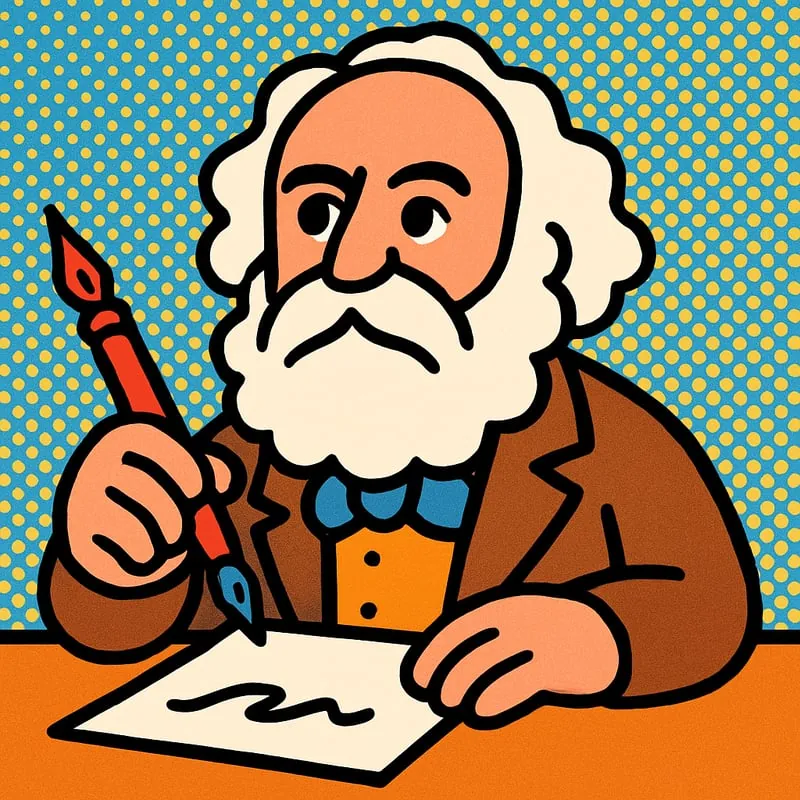
On February 27, 1807, in the coastal town of Portland, Maine, a baby named Henry Wadsworth Longfellow was born to a lawyer and his book-loving wife. The family lived right by the ocean, and young Henry grew up listening to the booming surf, the creak of ships, and the stories sailors told at the docks. He started writing poems at 13 and got his first one published in a local newspaper. By the time he was 18 he was off to college, gobbling up French, Spanish, German, and Italian along with math and history.
Longfellow became one of the most popular poets in American history. He wrote 'The Song of Hiawatha,' a long story-poem inspired by Native American legends, and 'Evangeline,' a tale of lost love during a wartime exile. But the poem schoolkids still know best is 'Paul Revere's Ride,' which begins 'Listen, my children, and you shall hear / Of the midnight ride of Paul Revere.' It told the story of the Revolutionary War hero who galloped through Massachusetts in 1775 to warn that the British were coming.
Longfellow's poems were read aloud in classrooms, churches, and parlors all over the country. When he visited England, kings, queens, and famous writers lined up to meet him. He helped invent the idea of America's own national poetry, drawing from its forests, its rivers, and its battles. His house in Cambridge, Massachusetts, is now a museum, and a giant statue of him still sits in Portland, Maine. Long after his death in 1882, his hoofbeat rhymes are still galloping through history class.