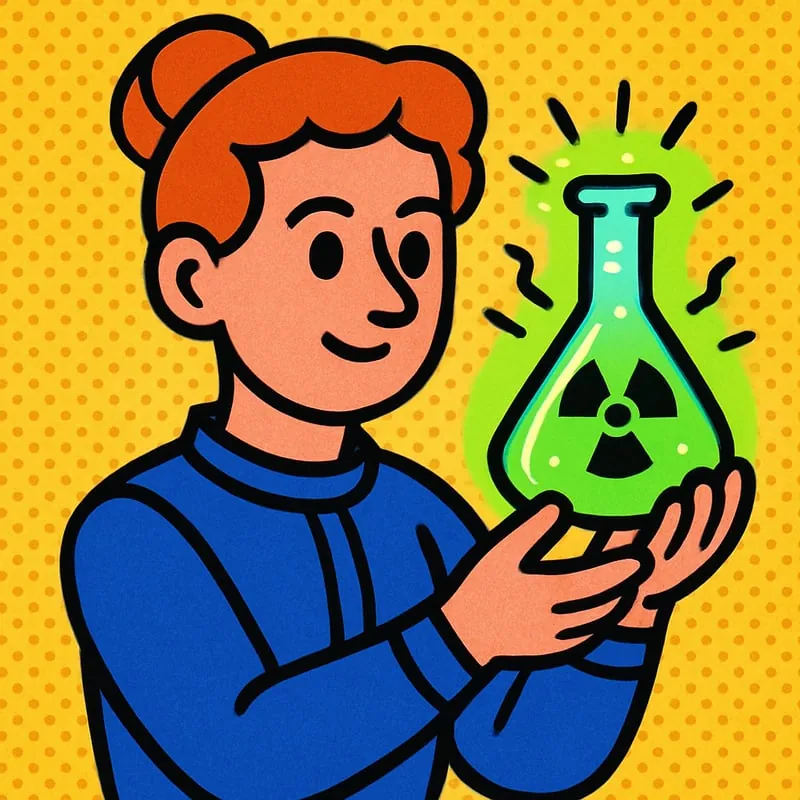
Marie Curie was working in a leaky, freezing shed in Paris with a husband named Pierre, two small children at home, and a hunch. She had been studying rocks that seemed to give off mysterious invisible rays. Tonnes of black rock, called pitchblende, kept being delivered to her shed. Marie boiled it, stirred it, and chemically separated it - for nearly four years - by hand, in giant vats.
On April 20, 1902, she finally produced one-tenth of a gram of pure radium chloride. It was a tiny pinch of white powder. But in the dark, it glowed bluish-green. Marie wrote in her notebook that she would sometimes go to the shed at night just to see her little jars shining like "faint fairy lights." She did not know yet how dangerous radium really was.
The Curies refused to patent their discovery. They believed science belonged to everyone. Marie went on to win two Nobel Prizes - first in Physics (1903), shared with Pierre and another scientist, and then in Chemistry (1911), entirely her own. She is still the only person ever to win Nobels in two different sciences.
Marie's exposure to radium did eventually make her sick, and she died in 1934 of complications from radiation. Her laboratory notebooks are so radioactive that they are kept in lead-lined boxes today. To read them, researchers must wear protective gear and sign a waiver.