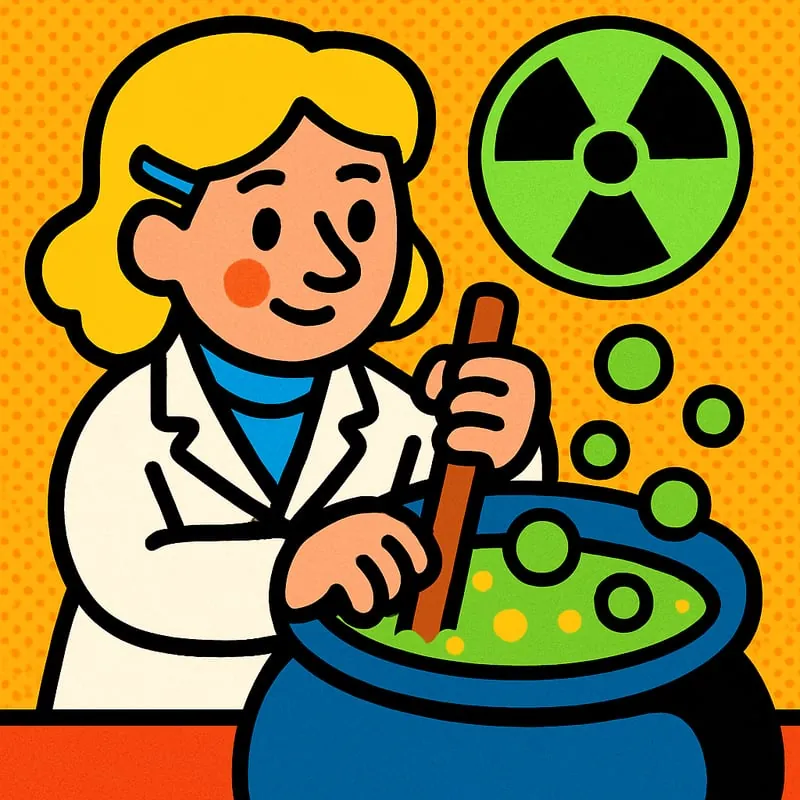
On December 26, 1898, in a freezing wooden shed in Paris, a scientist named Marie Curie and her husband Pierre announced that they had discovered a brand-new element. They called it radium, from the Latin word for ray, because it glowed faintly in the dark with a pale blue light. To find it, the Curies had spent nearly four years stirring giant pots of a black, sludgy mineral called pitchblende, sometimes using iron rods almost as tall as themselves. They processed several tons of the stuff just to get a teaspoon's worth of radium.
Marie had grown up in Poland, where girls were not allowed to attend universities. She moved to Paris, lived on bread and tea in an unheated attic, and studied so hard she sometimes fainted from hunger. She became the first woman to earn a doctorate in physics in France. When she and Pierre announced radium, the world was amazed. Glowing things were magical. For a while, people put radium in toothpaste, watch dials, and even candy, not yet understanding it was dangerously radioactive.
Marie went on to win the Nobel Prize in Physics in 1903 and the Nobel Prize in Chemistry in 1911, the first person to win two Nobel Prizes and still the only person to win them in two different sciences. During World War I, she drove mobile X-ray vans to the front lines to help doctors find bullets and broken bones in wounded soldiers. Marie died in 1934 from her years of radiation exposure, but her work led to cancer treatments that save millions of lives every year. Even her notebooks are still radioactive, locked away in lead-lined boxes.