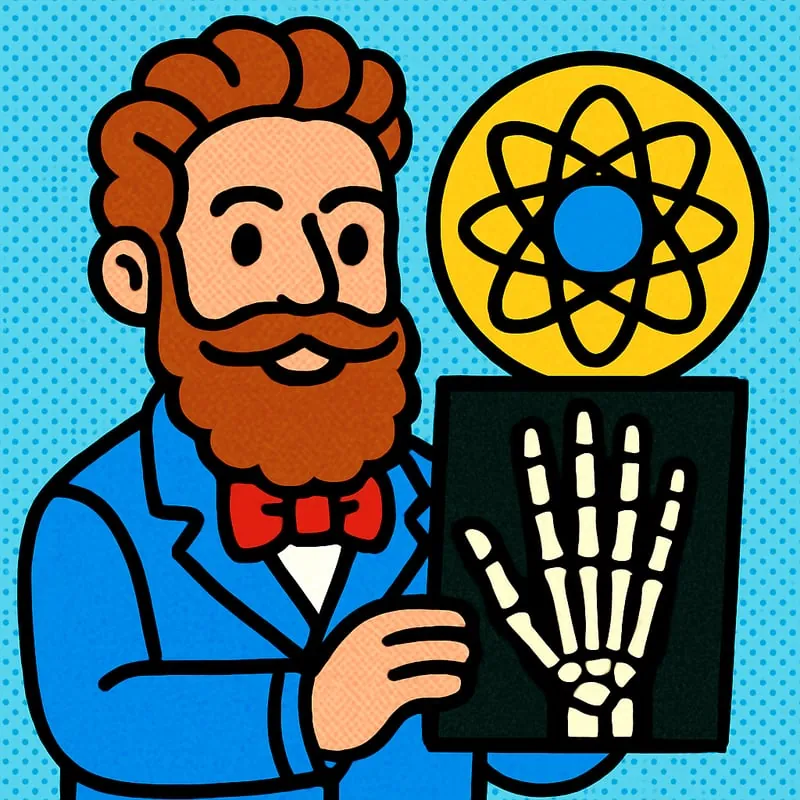
On March 27, 1845, in the German town of Lennep, a boy named Wilhelm Conrad Röntgen was born. He was not a particularly brilliant student. In fact, he was thrown out of his Dutch high school after refusing to identify a classmate who'd drawn a caricature of a teacher. He went on to study physics anyway, eventually becoming a professor in Würzburg, Germany. There, on a cold November evening in 1895, he made one of the most accidental and astonishing discoveries in science.
Röntgen was experimenting with a glass tube that produced strange invisible rays when electricity was passed through it. He noticed that a small fluorescent screen across the room was glowing, even though he'd carefully covered the tube with thick black cardboard. Something invisible was passing right through the cardboard. He spent weeks alone in his lab, even sleeping there, testing what this mysterious ray could pass through. When he held his hand in the beam, he could see the bones of his own fingers projected onto the screen. He called the rays "X" because in math, X means unknown.
Röntgen made the first X-ray photograph of a human body - his wife Anna's hand, with her wedding ring clearly visible on the finger bone. When she saw it, she reportedly cried, "I have seen my death!" Doctors immediately started using X-rays to find broken bones and bullets. Röntgen won the very first Nobel Prize in Physics in 1901, gave away his prize money, and refused to patent his discovery so it could help everyone. Today billions of X-rays are taken each year - every single one tracing back to a quiet professor and an accidentally glowing screen.