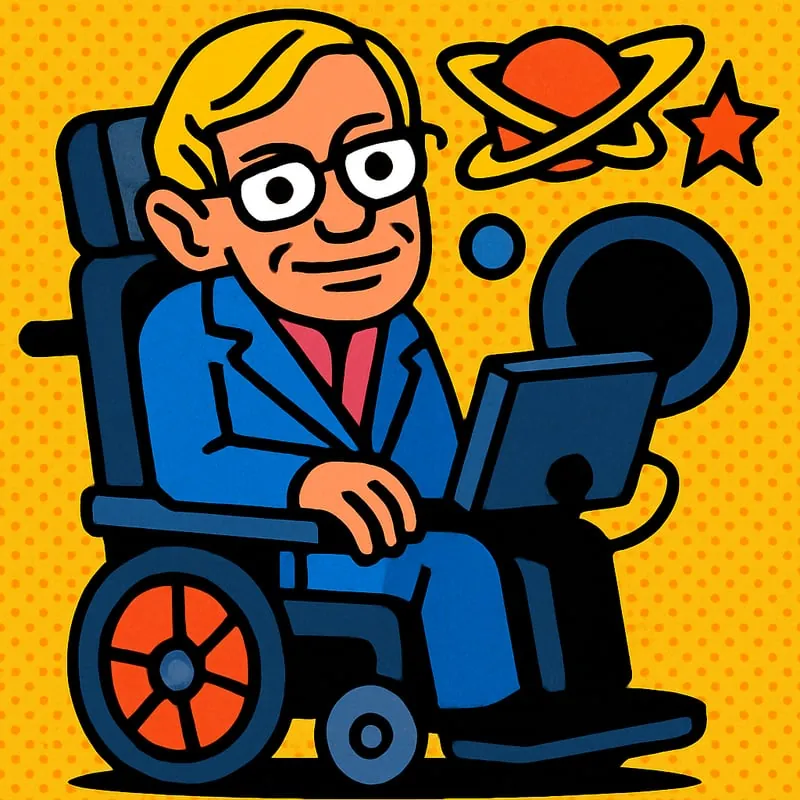
On March 14, 2018, the world said goodbye to physicist Stephen Hawking, who died peacefully at his home in Cambridge, England at age 76. The timing was extraordinary: he died on Pi Day, March 14, the same date Albert Einstein was born in 1879. And he had been born on January 8, 1942 - exactly 300 years to the day after the death of Galileo. The cosmos seemed to have arranged his bookends with care, as if even time itself agreed he belonged in the company of giants.
When Hawking was 21 and a graduate student, doctors told him he had a rare disease called ALS and predicted he had only a few years to live. He lived another 55. As his body slowly stopped working, he kept his brilliant mind busy puzzling out the biggest questions in the universe. He figured out that black holes aren't completely black - they slowly leak a tiny bit of energy now called Hawking radiation. He wrote A Brief History of Time, a book about the universe that sold over 10 million copies even though most readers admitted they didn't fully understand it.
Using a computer that spoke through a single cheek muscle, Hawking gave lectures around the world, floated in zero-gravity flights, appeared on The Simpsons and Star Trek, and proved that a brain trapped in a still body could roam farther than almost anyone alive. He was buried near Isaac Newton and Charles Darwin in Westminster Abbey. The boy who dreamed of becoming a scientist had become one of the great explorers in history, traveling all the way to the edge of a black hole without ever leaving his chair.