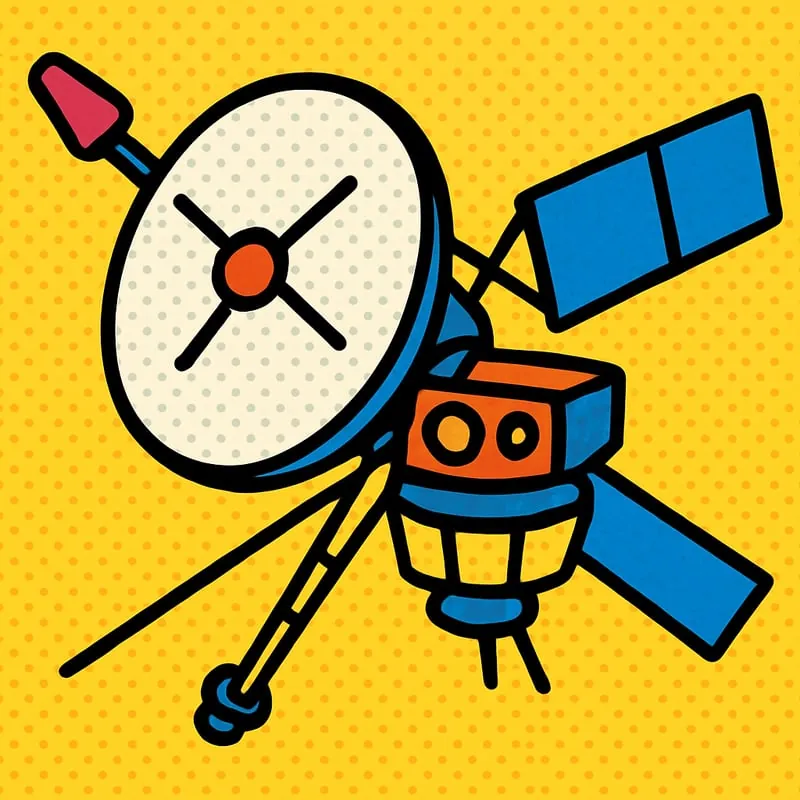
On September 5, 1977, a Titan-Centaur rocket roared off a launch pad in Florida carrying a school-bus-sized robot called Voyager 1. The mission plan was bold but simple: fly past Jupiter and Saturn, take lots of pictures, then just keep going. The engineers who built it hoped it might last five years. Almost fifty years later, it is still beeping back data from a place no human-made object has ever been.
Voyager 1 took mind-blowing close-ups of Jupiter's swirling red storm, watched volcanoes erupting on its moon Io, and discovered new rings around Saturn. Tucked on the side of the spacecraft is a golden record loaded with greetings in 55 languages, songs by Mozart and Chuck Berry, and the sound of a baby laughing, just in case aliens ever find it. In 2012, Voyager 1 became the first human-made object to cross into interstellar space, the region between the stars. In 2024, when it suddenly started sending gibberish, engineers in California spent months figuring out the problem and patching the code from over 15 billion miles away.
Right now Voyager 1 is so far that its radio signal, traveling at the speed of light, takes more than 22 hours to reach Earth. Its plutonium battery is running low and its instruments will switch off one by one over the next few years. But the spacecraft itself will keep gliding through the galaxy for billions of years, a metal time capsule from Earth quietly cruising past stars that haven't even been born yet.