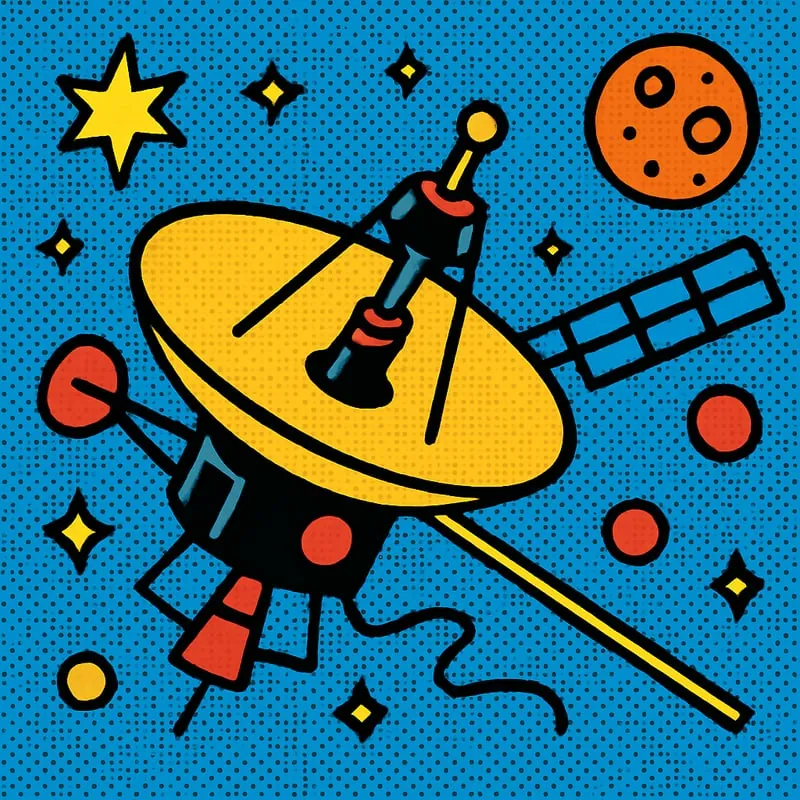
On August 20, 1977, a Titan-Centaur rocket roared off Launch Pad 41 at Cape Canaveral, Florida, carrying a strange little spacecraft no bigger than a small car. Voyager 2 was on its way to do something no probe had ever done: tour all four giant outer planets, one after another. Sixteen days later, its twin Voyager 1 launched right behind it. They were taking advantage of a rare alignment of planets that only happens once every 176 years.
For the next 12 years, Voyager 2 raced through the solar system snapping incredible pictures. In 1979 it flew past Jupiter and spotted volcanoes erupting on the moon Io. In 1981 it slipped through the gleaming rings of Saturn. In 1986 it became the first and only spacecraft ever to visit Uranus, finding ten new moons. In 1989 it skimmed past blue, windy Neptune and discovered ice geysers shooting off the moon Triton. Then it kept right on going.
Nearly 50 years after launch, Voyager 2 is still flying. It has crossed into interstellar space, the region between the stars, more than 12 billion miles from home. Each Voyager carries a Golden Record packed with greetings in 55 languages, music from Bach to Chuck Berry, and pictures of life on Earth, just in case some alien finds it someday. Its plutonium battery is finally running low, and by the 2030s the radio will go silent, but Voyager 2 will keep drifting through the galaxy for millions of years, a postcard from us.