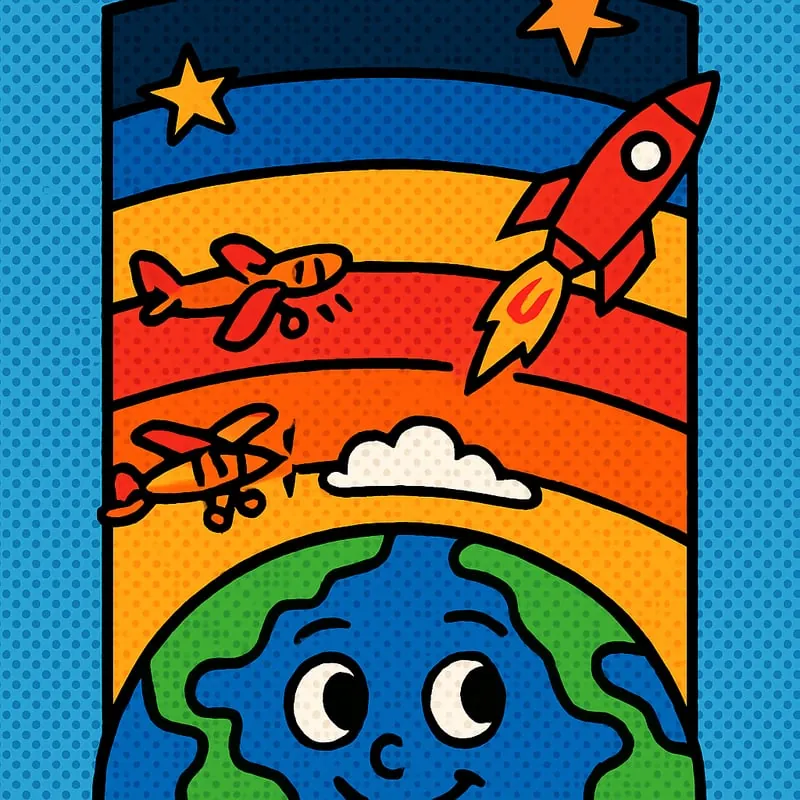
The blue sky above you isn’t a single thing. Earth’s atmosphere has five distinct layers, each with its own personality. They blend smoothly into each other, but the air, temperature, and pressure change dramatically between them.
The troposphere is the lowest, going from the ground up to about 12 km. It contains 75% of all our atmosphere, and basically all the weather: clouds, storms, rain. Airplanes mostly fly at its upper edge. Next is the stratosphere, where the ozone layer lives - a region of high-energy oxygen molecules that absorb most of the Sun’s harmful UV light. Hot air balloons can’t reach here.
Above that, the mesosphere is where meteors hit and burn up - those streaks across the sky at night happen 50-85 km up. Above the mesosphere lies the thermosphere, very thin air heated by the Sun to thousands of degrees. The International Space Station orbits in the thermosphere. And finally the exosphere slowly fades into the vacuum of space at altitudes of 700+ km. The boundary between atmosphere and space isn’t sharp; it’s a gentle thinning out.