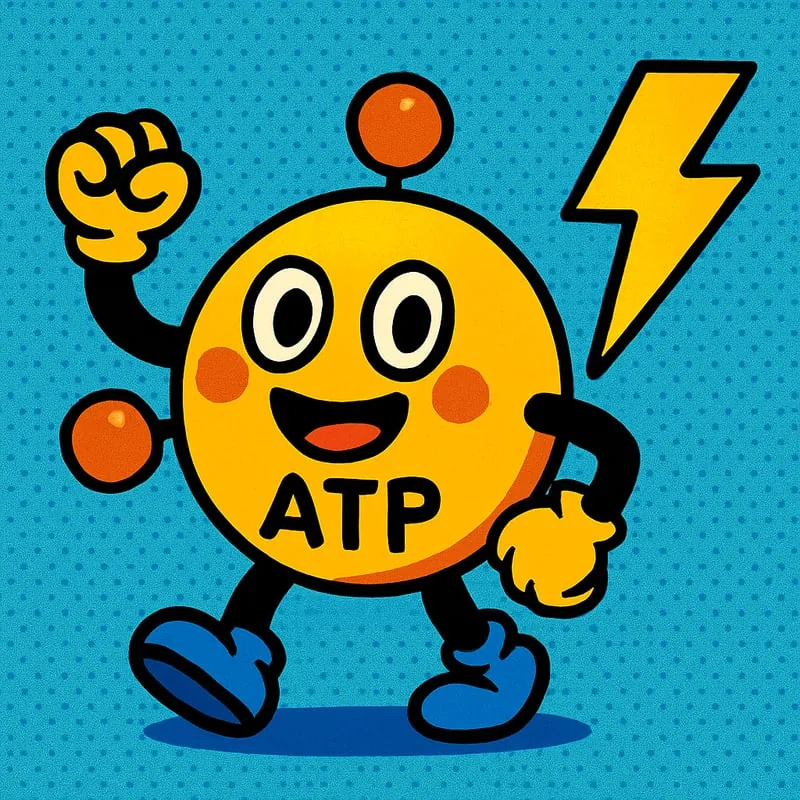
Every cell in every living thing on Earth uses the same molecule for energy: ATP (adenosine triphosphate). Plants use it. Animals use it. Bacteria use it. Mushrooms use it. It’s the universal energy currency of life - and it’s been that way for billions of years.
ATP works like a tiny rechargeable battery. When a cell does work - contracting a muscle, building a protein, firing a nerve signal - it spends an ATP molecule by breaking off one of its three phosphate groups, releasing energy. The “spent” ATP is then taken back to your mitochondria, where food energy is used to attach a fresh phosphate, recharging it back into full ATP.
Your body cycles through an astonishing amount of ATP. At any one moment, you only have a few grams of it on hand - but you’re constantly making and using more. Over a single day, the typical adult produces and uses about their own body weight in ATP molecules. Each one gets recycled hundreds of times before being broken down completely. It’s an incredible piece of biological engineering, finely tuned by billions of years of evolution.