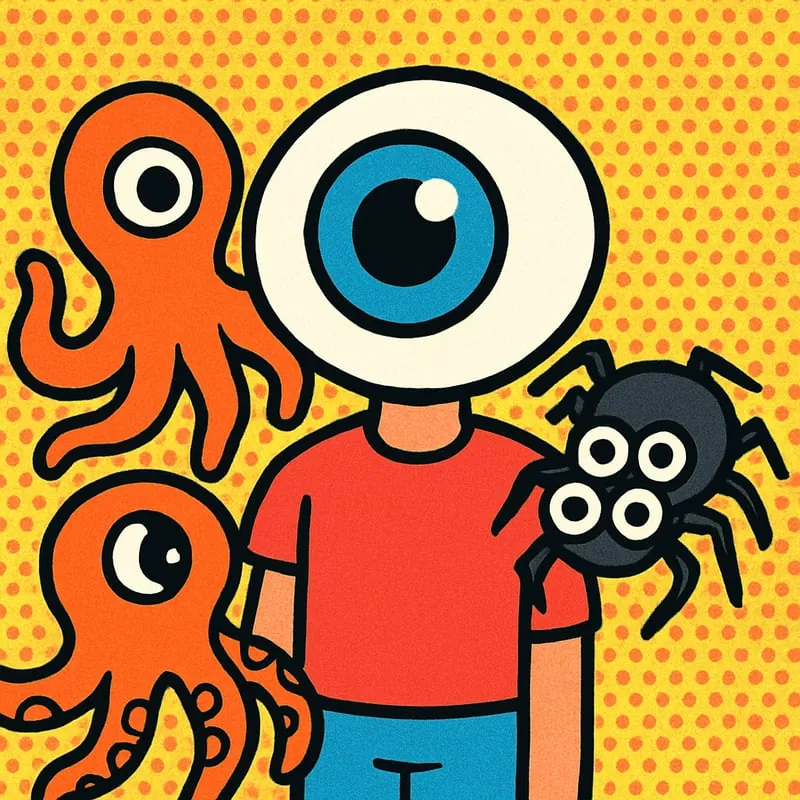
Eyes are so useful that evolution has invented them, from scratch, somewhere around 50 different times. The eyes of an octopus, a human, a fly, a scallop, and a jellyfish are all different “inventions” - each one developed independently by their lineage of ancestors.
All these independent eyes seem to have started with the same basic step: a patch of light-sensitive cells in some early animal. Once organisms could tell light from dark, evolution iteratively improved on the design. Some lineages built compound eyes, like flies. Others built pinhole eyes, like nautiluses. Some built camera-type eyes with lenses, like ours.
The most striking example: octopus eyes and human eyes. They look remarkably similar - both have a lens, an iris, a retina, all working basically the same way. But our last common ancestor was a worm-like creature about 600 million years ago that probably had nothing more than light-sensitive spots. Octopus eyes and human eyes evolved completely independently. Evolution arrived at almost identical designs through entirely separate paths, because the principles of optics force good eye designs to look certain ways.