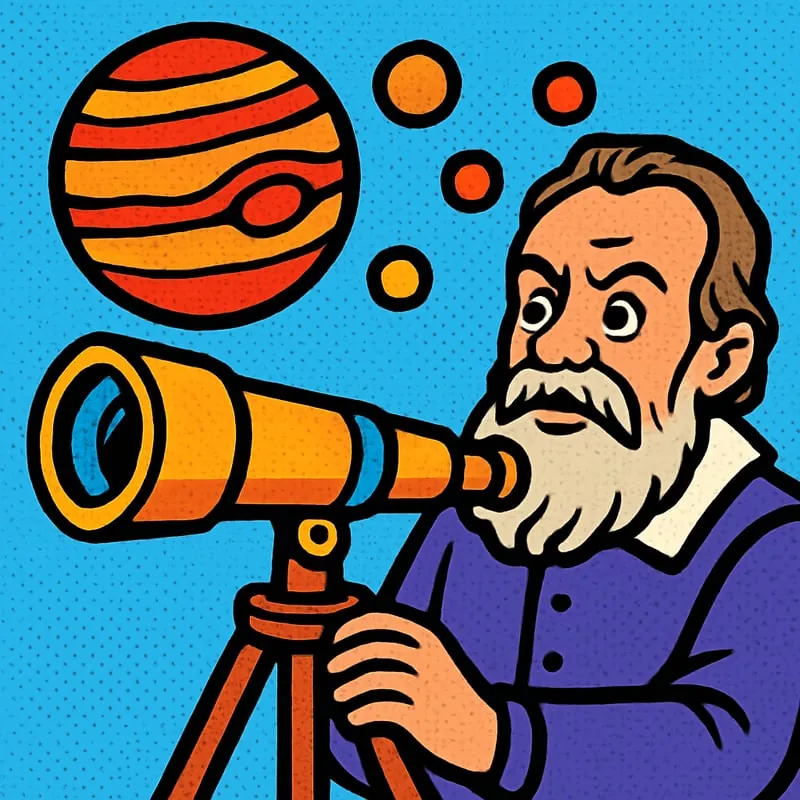
Galileo Galilei heard about a new Dutch invention called a “spyglass” in 1609 and built a much better version himself. He turned it on the night sky and saw things nobody had ever seen: craters on the Moon, hundreds of new stars, and tiny dots moving around Jupiter.
Those dots were moons - and they shouldn’t have been there. In Galileo’s day, almost everyone believed Earth sat at the center of the universe and that everything circled around it. Jupiter clearly had its own little system, which meant Earth wasn’t special.
The Catholic Church was furious. Galileo was put on trial, forced to take back his ideas, and spent the last nine years of his life under house arrest. But the moons kept orbiting, and today the four he discovered - Io, Europa, Ganymede, and Callisto - are still called the Galilean moons.