For centuries, scientists argued whether light was a particle or a wave. Isaac Newton thought particles. His rival Christiaan Huygens thought waves. By the late 1800s, waves seemed to be winning - experiments clearly showed light bending and diffracting and interfering with itself, exactly the way waves do.
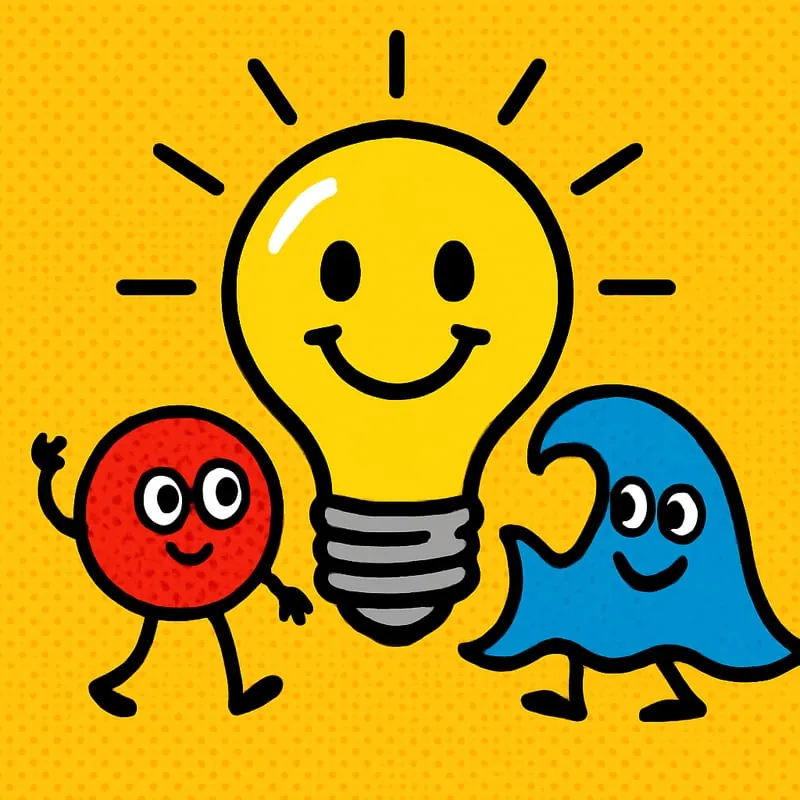
Then physicists started running stranger experiments. Albert Einstein and others noticed that light sometimes behaved like discrete chunks of energy - photons - particularly when interacting with matter. By the 1920s, it was clear that BOTH descriptions are correct. Light is both. It acts like a wave in some experiments, and like a particle in others, depending on what you’re measuring.
This isn’t a contradiction. It’s called wave-particle duality, and it’s a real fact about the universe at the quantum scale. Electrons and other tiny things show the same dual behavior. It seems to mean that the categories of “wave” and “particle” don’t actually fit the most fundamental level of reality - they’re just two ways our larger-scale brains approximate something weirder underneath.