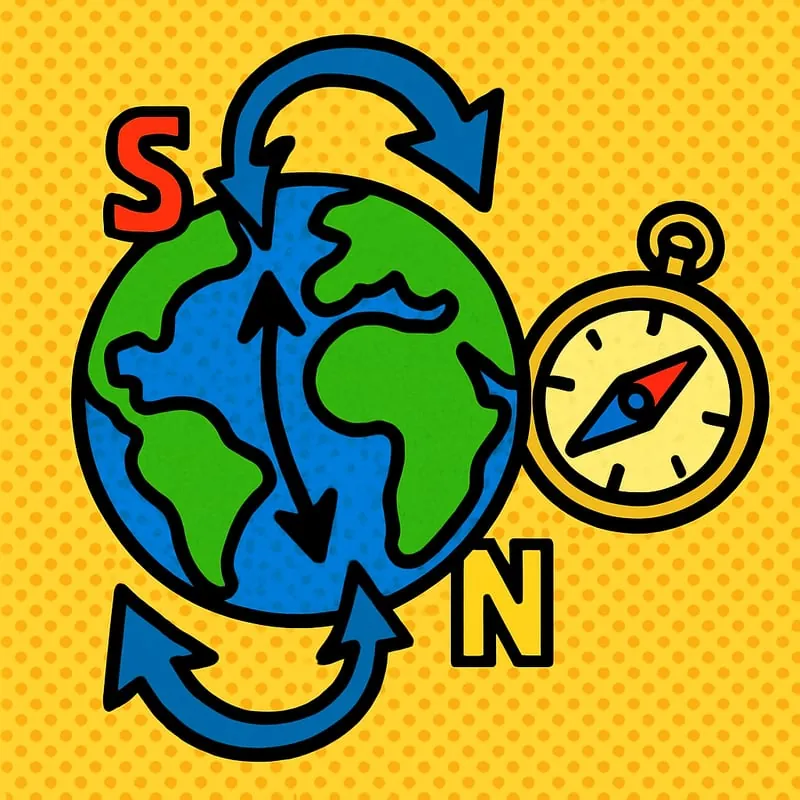
Earth has a magnetic field generated by the slow churning of molten iron in its outer core. Most of the time, this field has a north and south pole that roughly match the geographic poles, and compasses work the way you’d expect. But the field isn’t permanent. Every few hundred thousand years on average, it flips upside down. North becomes south. South becomes north. Compasses, if anyone were holding one, would suddenly point the opposite direction.
We know this because we can read the magnetic record in rocks. When lava cools and hardens, magnetic minerals in it lock in the direction of Earth’s magnetic field at that moment. By studying layers of volcanic rock around the world, geologists have mapped out hundreds of flips going back hundreds of millions of years. The last flip was about 780,000 years ago - and the one before that, 1.07 million years ago.
The field is currently weakening, which sometimes happens before a flip (though it can also just rebound). If a flip is coming, it won’t be sudden. The process probably takes thousands of years, and during the transition the field gets weaker, allowing more solar radiation through. There’s no evidence past flips caused mass extinctions, but they could affect satellites, electronics, and migrating animals that use the magnetic field to navigate.