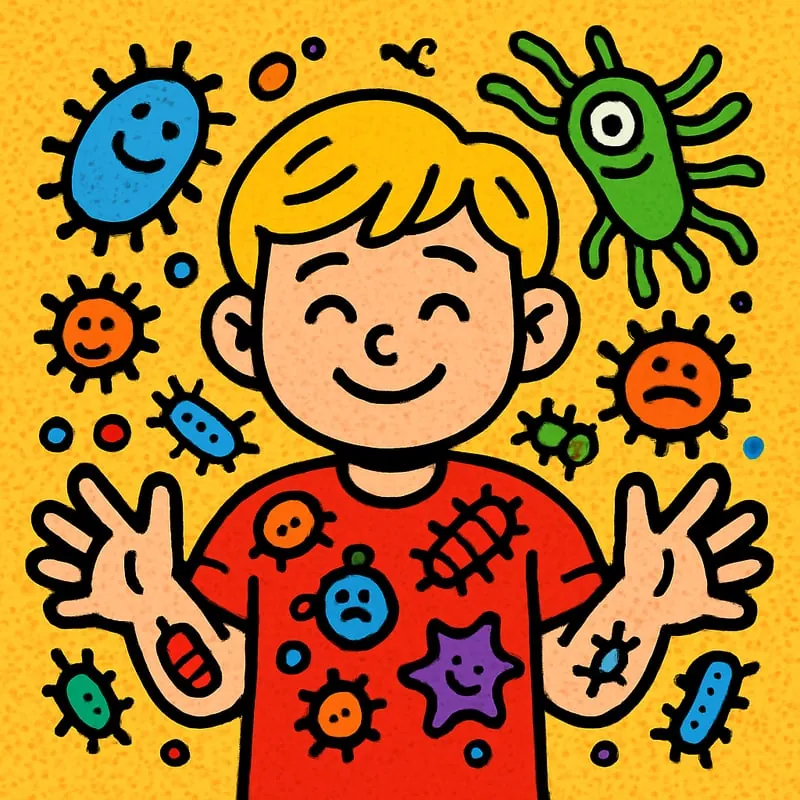
You’d probably consider yourself a “human.” Numerically, that’s mostly - but not entirely - true. Your body contains roughly 30 trillion human cells and is home to around 38 trillion bacterial cells. Scientists now estimate the ratio is essentially 1:1, give or take. By cell count you’re about half microbe; the bacteria all together only weigh around half a pound.
Most of those bacteria live in your gut, where they help digest food, produce vitamins, and outcompete bacteria that could make you sick. Others live on your skin (about 1,000 species), in your mouth (around 700 species), in your nose, your eyelashes, and even up your nose. Together, this community is called your microbiome.
Far from being a problem, your microbiome is essential. People who lose their gut bacteria - from antibiotics, illness, or transplants - often suffer digestive problems, weakened immune systems, and mood changes. Some scientists think the microbiome even influences our personalities and food cravings. The boundary between “you” and “all the tiny things living in you” is fuzzier than it feels.