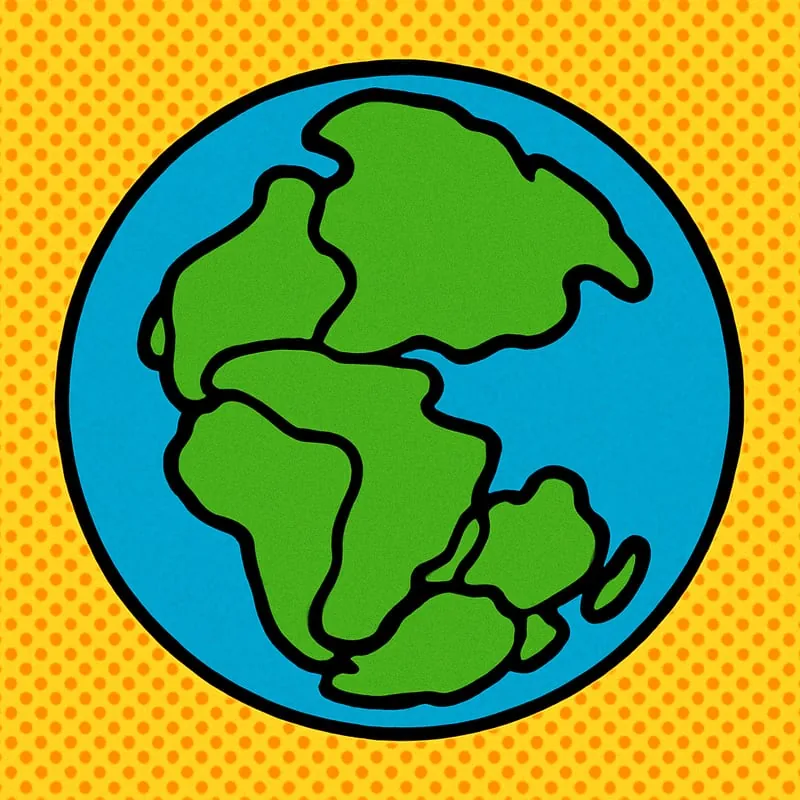
Take a look at a world map. Notice how the eastern coast of South America and the western coast of Africa look like they would fit together pretty well - like two halves of a puzzle piece. That isn’t a coincidence. About 200 million years ago, they really were attached. So was everything else. All the continents we have today were squished into one single supercontinent called Pangaea, which means “all earth” in Greek.
Pangaea formed about 335 million years ago when several earlier continents collided. For tens of millions of years, it stayed as one. There was a single global ocean called Panthalassa surrounding it. Then, about 175 million years ago, Pangaea started breaking apart. First into two big chunks (one of which contained North America, Europe, and Asia; the other contained South America, Africa, Antarctica, India, and Australia). Then those broke apart further, drifting to where they sit today.
The drift is still going on. North America and Europe are still moving apart at about an inch a year. India is still slowly ramming into Asia, pushing the Himalayas higher. About 250 million years from now, the continents are predicted to crash back together into a brand-new supercontinent. Geologists already have a tentative name for it: Pangaea Ultima.