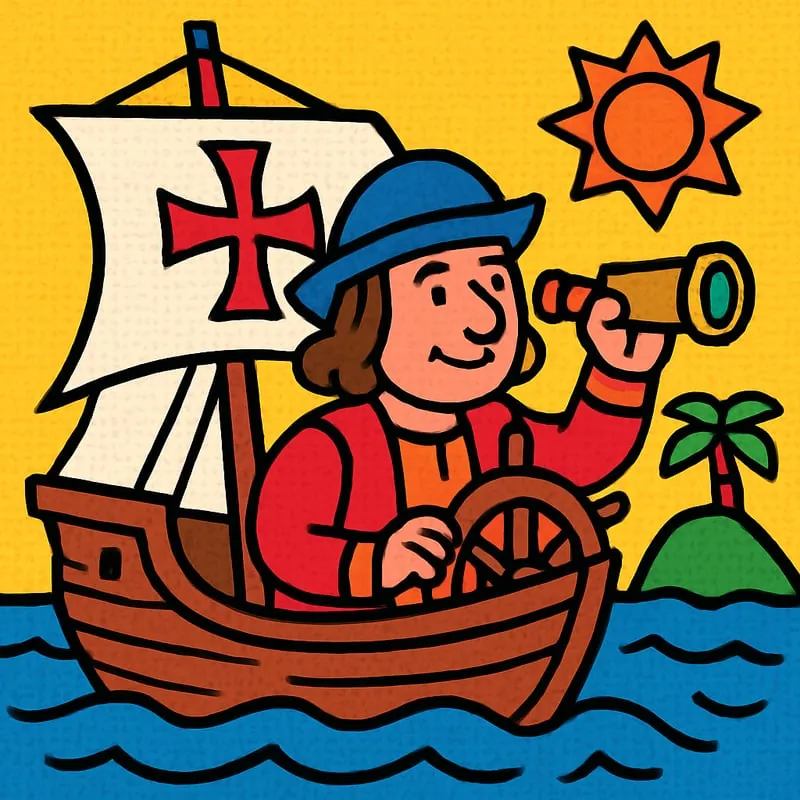
Before sunrise on October 12, 1492, a sailor named Rodrigo de Triana stood watch high on the mast of a small ship called the Pinta. Through the moonlight he spotted a thin pale line on the horizon. 'Tierra! Tierra!' he shouted - Land! Land! The three ships of Christopher Columbus's expedition had crossed the Atlantic Ocean from Spain in 36 days. At dawn they came ashore on a Bahamian island the local Lucayan people called Guanahani. Columbus planted a flag and renamed it San Salvador.
Columbus had set out with the Niña, the Pinta, and the Santa María, looking for a shortcut to Asia by sailing west. He had no idea two enormous continents stood in his way. The people who came out to meet his ships had been living in the Americas for thousands of years, in cities and farms and trading networks that stretched from the Arctic to the tip of South America. Columbus called them 'Indians' because he wrongly believed he had reached the Indies near India. He made four voyages in total and never realized he had landed on a brand-new continent for European maps.
The meeting that October morning changed both halves of the world forever. Plants, animals, ideas, and diseases began flowing between the Americas, Europe, Africa, and Asia in what's now called the Columbian Exchange. Tomatoes traveled to Italy. Horses returned to the Americas. The voyage opened doors - but also brought terrible hardship to the people already living there. October 12 is still marked across the Americas, sometimes as Columbus Day, sometimes as Indigenous Peoples' Day, sometimes both at once.