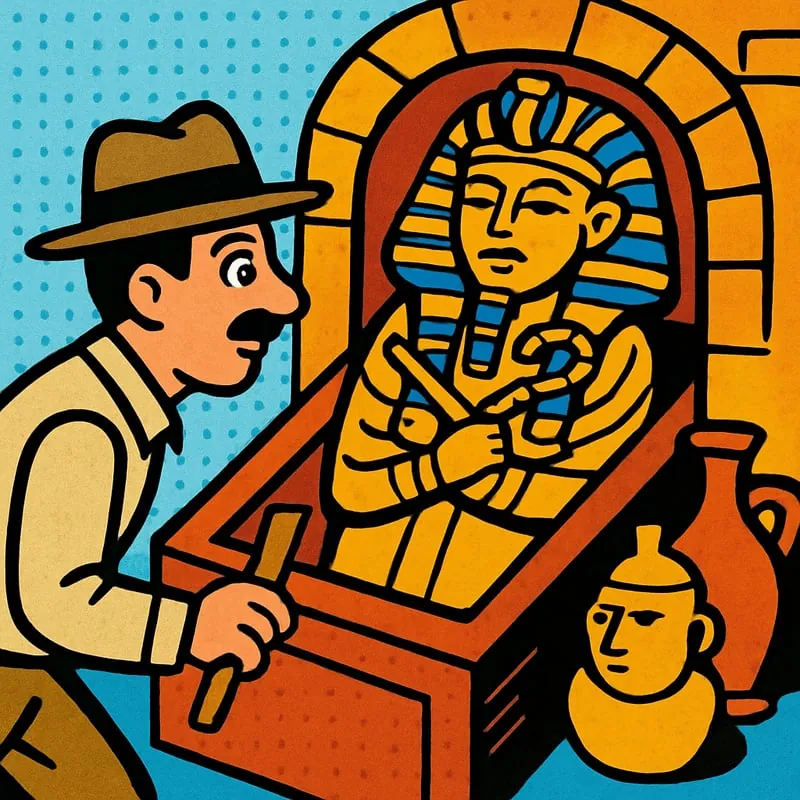
On November 4, 1922, in a dusty Egyptian valley where everyone said all the good tombs had already been found, a water boy named Hussein Abdel-Rassoul accidentally kicked a stone step buried in the sand. Within hours, archaeologist Howard Carter and his team were brushing away thousands of years of grit to uncover a hidden staircase. At the bottom, behind a sealed door, was the almost-untouched tomb of a teenage pharaoh named Tutankhamun who had died around 1323 BC.
Carter had been digging in the Valley of the Kings for six years with no luck, and his rich British backer, Lord Carnarvon, had warned him this would be the last season. Three weeks later, when Carter finally chipped a small hole into the inner burial chamber and held up a candle, Carnarvon asked, Can you see anything? Carter answered, Yes - wonderful things. Inside were more than 5,000 objects: golden chariots, jeweled daggers, board games, sandals, fans of ostrich feathers, and a solid gold mask weighing 22 pounds covering the boy king's face.
The discovery sparked Tut-mania across the world. Newspapers ran daily updates, songs were written about the boy king, and fashion suddenly featured Egyptian patterns and gold jewelry. It took Carter ten years to catalog everything in the tomb. Most of those treasures now live in Cairo, where millions of visitors still line up to see them. King Tut wasn't a famous pharaoh in his own lifetime, but his hidden tomb made him the most recognizable face from ancient Egypt - proof that history sometimes saves its biggest surprises for last.