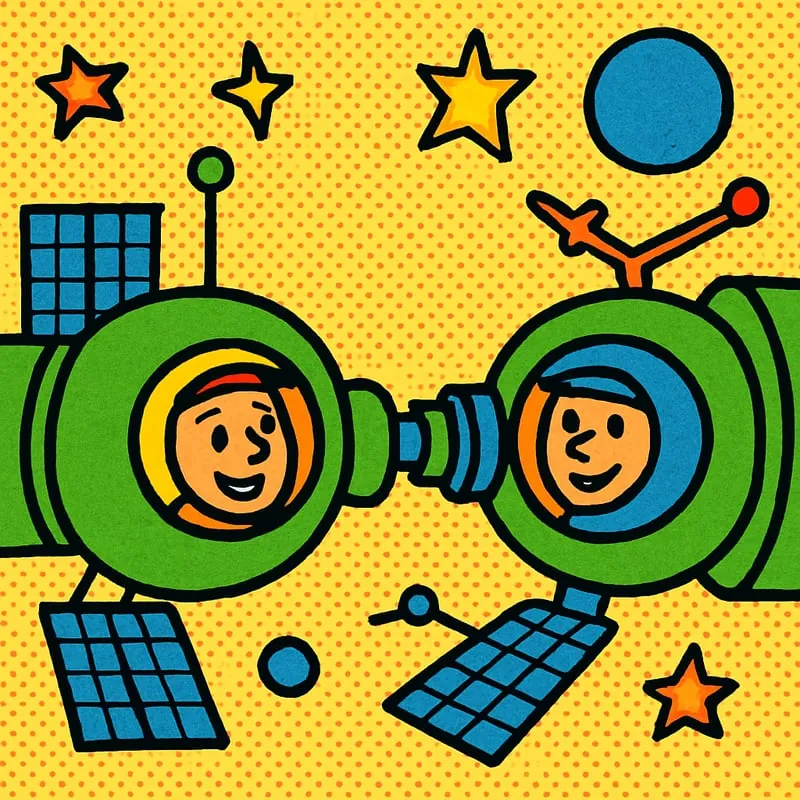
On 16 January 1969, two Russian spacecraft were chasing each other in orbit, 142 miles above the Earth. Soyuz 4 had launched on the 14th with one cosmonaut, Vladimir Shatalov. Soyuz 5 had blasted off the next day with three crewmates. They circled the planet for two days, slowly creeping closer. Finally Shatalov reached out with his ship's docking probe and clicked into Soyuz 5. It was the first time in history that two crewed spacecraft had latched together in space.
What happened next was even bolder. Two of the cosmonauts on Soyuz 5 - Aleksei Yeliseyev and Yevgeny Khrunov - squeezed into bulky white spacesuits, opened the hatch, and floated outside into the black vacuum. They crawled hand over hand along the outside of the two joined ships and climbed into Soyuz 4. It was the first ever crew transfer between two spacecraft, and they did it without a tunnel - just space, stars, and their tethers. Soviet newspapers called the linked ships 'the world's first experimental space station.'
The linkup was a huge moment in the space race. The Americans were just six months away from putting Neil Armstrong on the Moon, but Soviet engineers were already practising the trick of joining ships together - a skill the world would soon need to build Mir, the International Space Station, and even today's rotating crew rotations on the ISS. Every time a SpaceX capsule docks with the station now, it follows in the path quietly carved by those four cosmonauts in 1969.