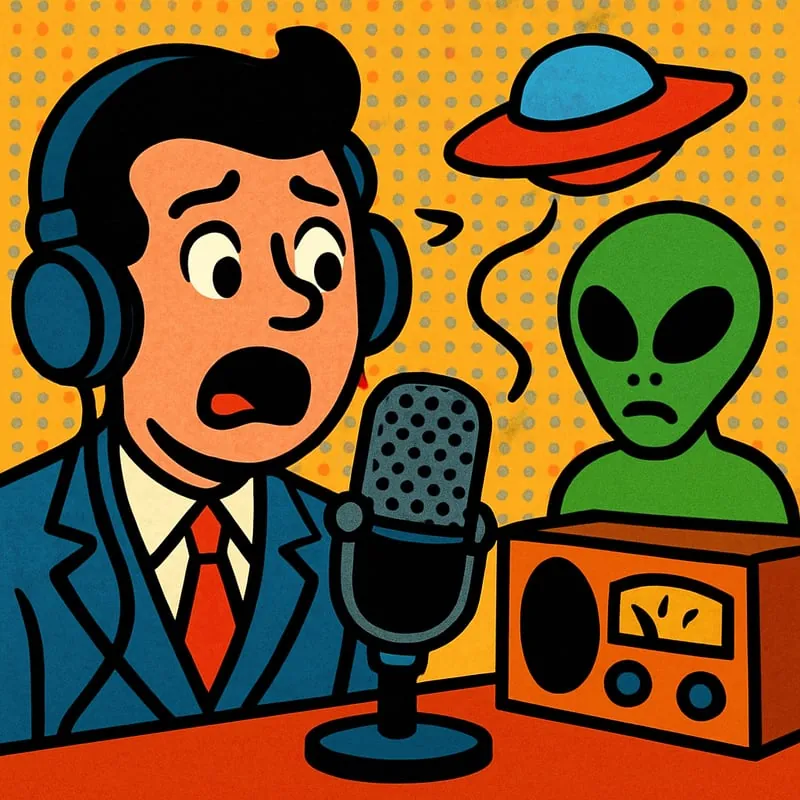
On the evening of October 30, 1938, millions of Americans tuned their radios to CBS to hear a Sunday-night drama show called The Mercury Theatre on the Air. The director was a 23-year-old wonder named Orson Welles. Tonight's episode was an adaptation of H. G. Wells's novel The War of the Worlds, retold as a series of pretend live news bulletins. The show began with normal-sounding music. Then an announcer broke in. Astronomers had detected strange explosions on Mars. Then a giant metal cylinder had crashed in Grover's Mill, New Jersey. Then aliens were climbing out.
Many listeners had tuned in late and missed the introduction explaining it was a play. The fake news bulletins sounded exactly like real ones, with reporters shouting over crowds, military officers being interviewed, and dramatic 'live' updates. Some listeners panicked. Phone lines lit up at police stations across the country. A few people fled their homes. Newspapers the next day printed huge headlines about the mass panic - though later studies showed the real chaos was much smaller than the papers claimed. Most listeners knew it was fiction. But the legend grew anyway.
For Orson Welles, the broadcast turned him into a household name overnight. Two years later he co-wrote, directed, and starred in Citizen Kane, often called the greatest movie ever made. The War of the Worlds broadcast became a famous warning about how powerful media can fool people - a lesson that gets brought back up every time a new technology, from television to social media to AI, makes it easier than ever to blur the line between what's real and what isn't.