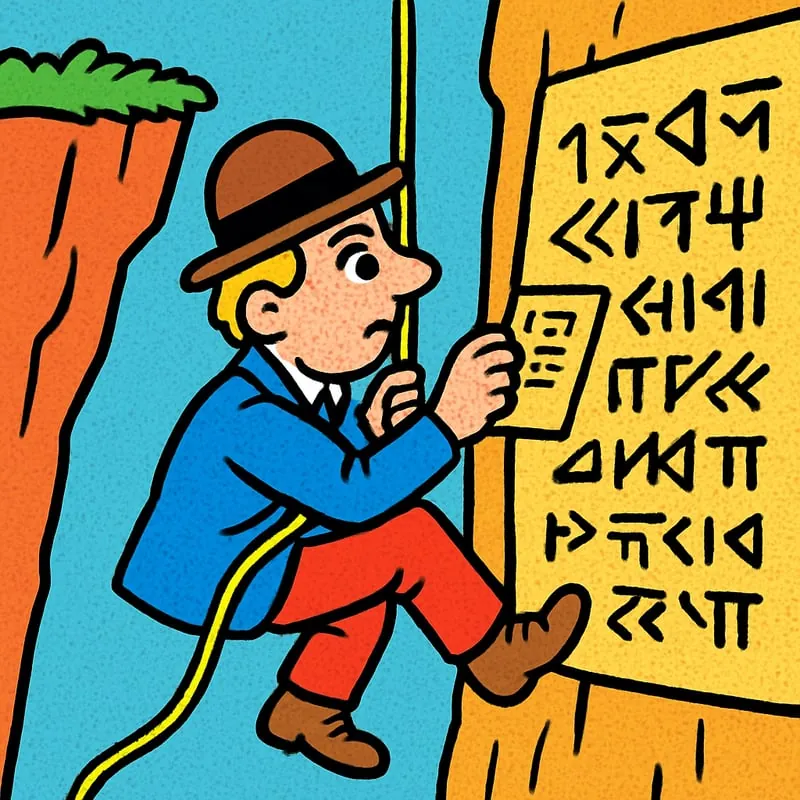
In the 1830s, a young British soldier named Henry Rawlinson was stationed in what is now Iran. High on a cliffside near a town called Behistun, he could see a huge ancient carving - over 300 feet off the ground. It showed a Persian king and several lines of mysterious wedge-shaped writing in three different languages.
Rawlinson realized the inscription might be a key. If the same text was written in three languages, and scholars could read one of them, the others could be cracked. He spent years risking his neck to copy it, scaling the cliff, balancing on narrow ledges, and even getting a brave local boy to dangle from ropes to reach the most dangerous sections.
His copies - combined with work by other scholars - eventually cracked Old Persian, then Elamite, then Akkadian cuneiform. Suddenly historians could read thousands of clay tablets from ancient Mesopotamia, including laws, letters and the world’s oldest novel, the Epic of Gilgamesh. One cliff carving reopened 3,000 years of buried history.