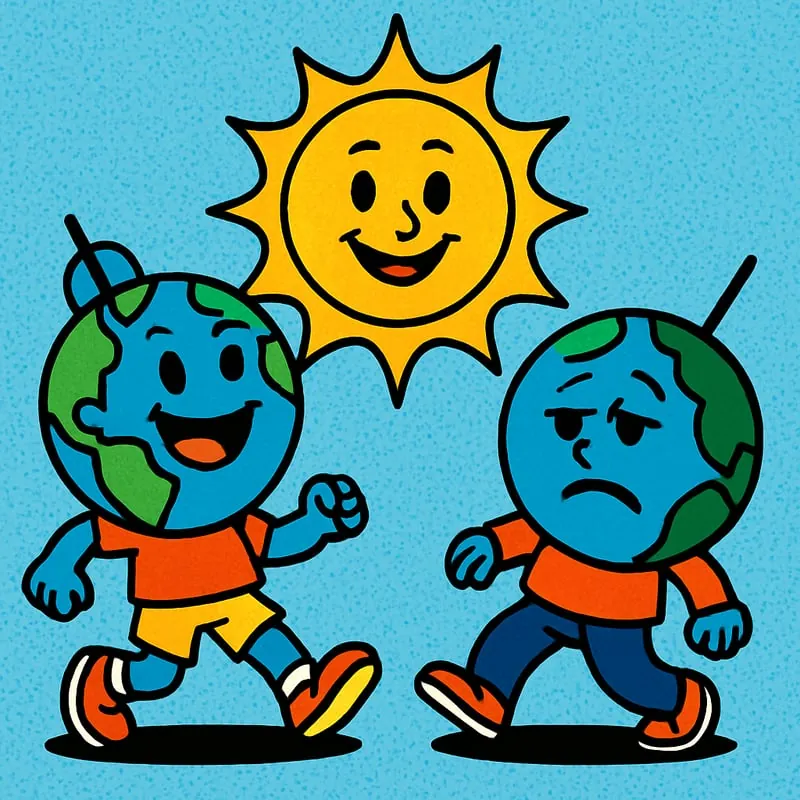
The solstices are the two times each year when Earth’s tilt is most extreme - when one hemisphere is angled most directly toward the Sun, and the other most directly away. The Northern Hemisphere’s summer solstice happens around June 21, when the North Pole is tilted toward the Sun. The winter solstice is around December 21, when it’s tilted away.
On the summer solstice, you get the longest day of the year (in the Northern Hemisphere) and the shortest night. The Sun appears highest in the sky at noon. In places near the Arctic Circle, the Sun never fully sets - you get a “midnight sun.” On the winter solstice, the opposite is true: shortest day, longest night, lowest Sun. North of the Arctic Circle, the Sun never rises at all on that day.
The word solstice comes from Latin, meaning roughly “Sun stops.” For a few days around each solstice, the Sun’s apparent path across the sky shifts very little - it seems to “stand still” at its highest or lowest point before reversing direction. Many ancient cultures observed and celebrated solstices - Stonehenge in England is famously aligned to mark sunrise on the summer solstice.